
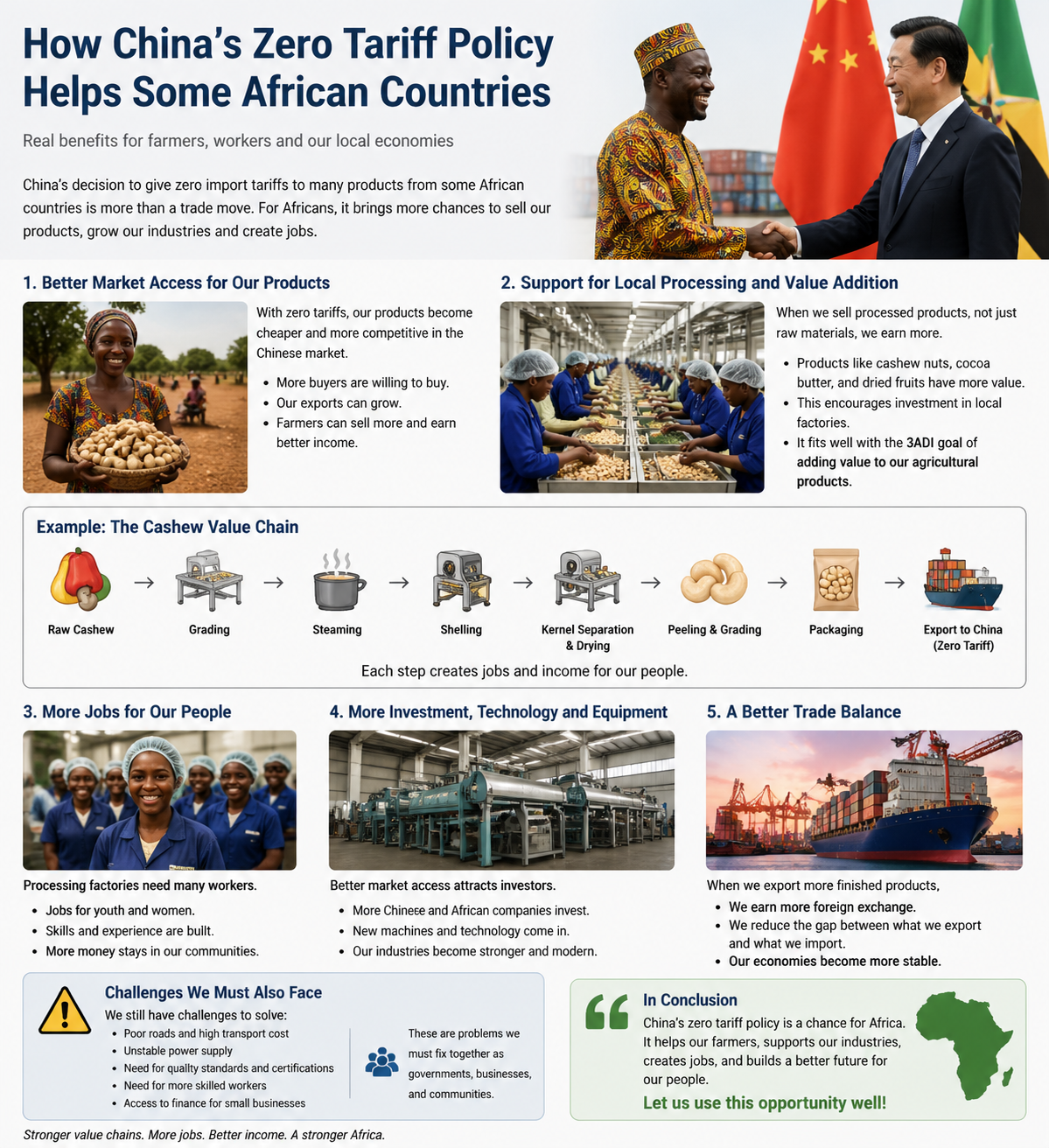
China has recently granted tariff exemptions to certain African countries. For many African farmers and small businesses, this is not just a policy on paper—it is a change they can feel in their daily work. Let’s look at the main benefits, using examples from the cashew industry and other agricultural sectors.
Farmers Get Better Market Access and Fairer Prices
Many African countries grow crops like cashew nuts, cotton, and coffee. In the past, farmers often struggled because:
- Raw products were hard to sell abroad
- Prices fluctuated and often remained low
With China removing import tariffs:
- African products become more competitive in price
- Exporting becomes simpler and less costly
- Buyers are more willing to make stable agreements
This helps farmers move from just surviving on their harvests to earning steady income. More income means better food, education, and opportunities for families.
Local Processing Becomes More Attractive
Previously, Africa exported mostly raw products. The real profits often stayed in countries that processed these goods. For example, the cashew industry involves several steps:
- Grading
- Cooking and shelling
- Drying and peeling
- Sorting and packaging
These steps can be done in local factories, creating more value before export. When products enter China tariff-free:
- Processed goods, such as cashew kernels, are more profitable
- Local businesses are encouraged to invest in processing equipment
- This builds the industrial capacity of African countries
Job Creation Beyond Farming
Processing agricultural products locally creates jobs that farming alone cannot provide. For a typical cashew factory:
- Machine operators handle shellers, dryers, and graders
- Workers manually sort and package kernels
- Logistics staff manage shipment
One processing plant can provide dozens or even hundreds of jobs. This supports women, youth, and men in rural and urban areas, boosting the local economy.
Attracting Technology and Investment
Tariff exemptions make exports more predictable and profitable, which attracts:
- Chinese companies to invest in local processing plants
- African businesses to upgrade machinery
- Partnerships and joint ventures
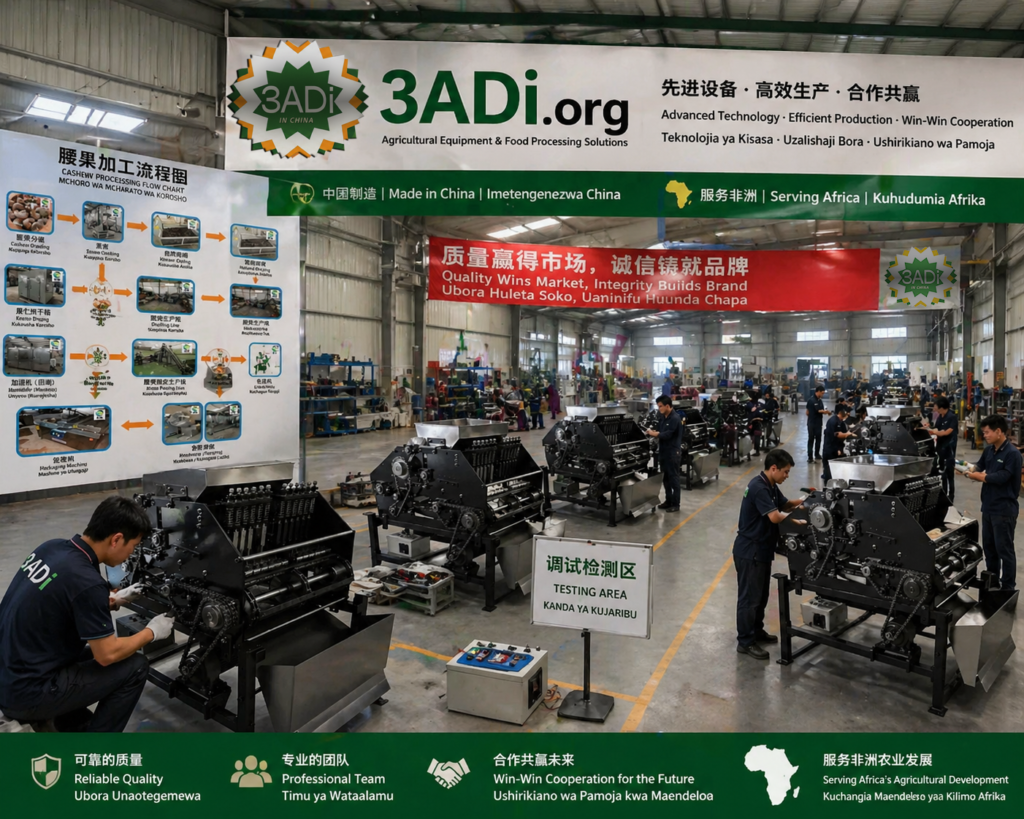
Already, Chinese companies supply African markets with grading machines, shellers, dryers, and full production lines. Tariff-free access encourages them to go beyond just selling machines—they may help build entire local industries.
Strengthening Trade Balance
Traditionally, African countries exported raw materials and imported finished goods. This often:
- Creates dependency
- Limits value captured locally
When African countries process goods locally and export higher-value products:
- Trade balance improves
- Local industries grow
- Countries rely less on importing finished goods
Challenges to Keep in Mind
Tariff-free access is not magic. African businesses still face challenges:
- Limited processing capacity – need electricity, skilled workers, and equipment maintenance
- High logistics cost – shipping from inland to port remains expensive
- Quality and standard requirements – buyers, especially in China, expect consistent quality
Governments, local businesses, and international partners like 3ADI can help address these gaps.
China’s tariff-free policy helps African countries in concrete ways:
- Farmers earn more
- Local processing industries grow
- Jobs multiply
- Technology and investment increase
- Trade balance improves
When combined with local industrial development, this policy can transform African agriculture from subsistence farming into a value-generating industry—exactly the vision promoted by 3ADI.